
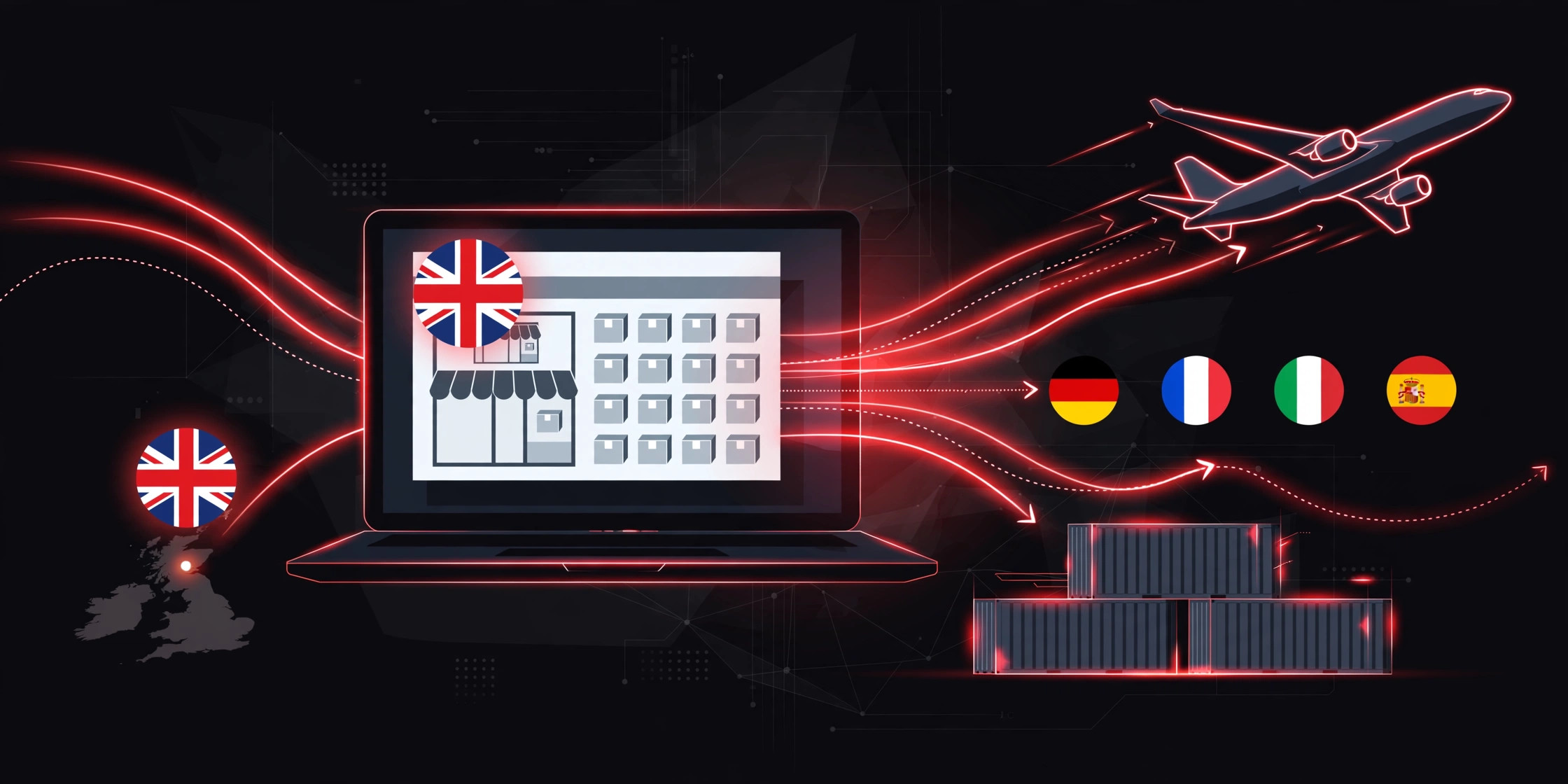
Want to sell on Amazon UK and expand across Europe? This guide walks through the whole process — setting up your Amazon UK seller account, understanding VAT and compliance at a high level, using Pan-EU fulfillment, translating your listings, and choosing which marketplaces to start with — so you can launch with confidence in 2026.
If you want to sell on Amazon UK in 2026, you are targeting one of the most mature e-commerce audiences in the world. British shoppers buy online at some of the highest per-capita rates anywhere, amazon.co.uk is a daily habit for millions of them, and a single UK listing can become the springboard into Germany, France, Italy, and Spain. This guide explains how to sell on Amazon Europe the practical way: the accounts you need, how fulfillment works across borders, what to know about VAT and compliance at a high level, and how to make your listings feel local in every market.
A quick note: this is a practical business guide, not tax or legal advice. VAT rules change and depend on your situation — wherever tax comes up, we will flag it and recommend a qualified tax professional.
Why You Should Sell on Amazon UK in 2026
For sellers based in the USA, Canada, or anywhere English is your working language, the UK is the most natural first international market on Amazon. There is no translation to do before your first sale, the consumer culture is familiar, and amazon.co.uk carries deep buyer trust — Prime delivery, easy returns, and a review culture that rewards sellers who get the basics right.
The UK also works as a gateway. One European Seller Central account can list across the UK and the EU marketplaces, which means the operational muscle you build on amazon.co.uk — listings, reviews, advertising, fulfillment — transfers directly when you expand to Germany, France, Italy, and Spain. You learn the European rulebook once, in English, and then reuse it.
There is also a competitive angle: many amazon.co.uk niches are less crowded than their US equivalents, and sellers who arrive with proper brand assets — Brand Registry, A+ Content, sharp images, and a real review strategy — can rank and convert faster here than in the US.
Amazon UK vs Amazon Europe: Where Should You Start?
Amazon runs separate marketplaces for each major European country, and each one behaves a little differently. Here is the honest rundown:
- Amazon.co.uk (United Kingdom): the obvious beachhead. English listings, UK consumer-protection norms, and Prime delivery expectations. Start here if English is your language.
- Amazon.de (Germany): Europe's largest Amazon marketplace. German shoppers research carefully and reward strong seller ratings — listings must be in proper German, not machine translation.
- Amazon.fr (France): a brand-conscious market where polished presentation matters. French-language listings are required.
- Amazon.it (Italy) and Amazon.es (Spain): fast-growing and often less competitive per niche — good second-wave targets once the UK and Germany are stable.
You manage all of these from one European Seller Central account. Our recommended sequence: prove the product on amazon.co.uk first, expand to Germany and France next, then add Italy and Spain.
One warning: selling on amazon.de from UK-held stock means slower, pricier cross-border shipping — and it shows in your Buy Box share. Local or Pan-EU fulfillment is what makes EU marketplaces convert.
How to Sell on Amazon UK: Account Setup and Requirements
Setting up to sell on Amazon UK is straightforward, but Amazon's verification is strict — expect to provide government-issued ID, bank account details, and business information, and allow several days for approval. Start the account process before your inventory is ready to ship, not after.
- Choose your selling plan: the Professional plan is the right choice for serious sellers (it unlocks advertising, brand tools, and category approvals); the Individual plan suits very low volume testing.
- Business entity: Amazon allows individuals and sole traders to sell on amazon.co.uk, but a registered company simplifies taxes, unlocks wholesale supplier accounts, and looks professional. International sellers commonly set up a UK limited company or a US LLC depending on their overall strategy — if the US route fits your plans, read our guide to LLC formation for non-residents.
- Banking and currency: Amazon disburses in local currency, so plan how you will receive GBP (and later EUR) and convert it cost-effectively.
- Product identifiers: most listings need valid GTINs/UPCs from the official source — fake barcodes lead to takedowns.
- Category approvals: some categories and brands are gated and need extra approval or distributor invoices.
- Brand Registry (recommended): trademark owners should enroll to unlock A+ Content, Brand Analytics, and Vine reviews.
If the setup feels like a lot, our marketplace account creation service handles it for you — done correctly the first time.
How Pan-EU Fulfillment Works
Fulfillment is where European selling gets interesting. Amazon offers two main cross-border models, and the difference matters:
- European Fulfillment Network (EFN): you store in one country and Amazon ships each order cross-border. Simple, but slower and pricier per order.
- Pan-European FBA (Pan-EU): you send inventory to one EU country and Amazon distributes it across its European network based on expected demand. Buyers everywhere get fast local delivery — a major lift to conversion and Buy Box share.
Two things to know. First, the UK sits outside the EU network since Brexit: UK inventory serves amazon.co.uk, EU inventory serves EU marketplaces — plan the two pools separately. Second, storing goods in another country can create VAT obligations there — have a tax professional review your setup before enabling Pan-EU.
Getting inventory from factory to Amazon's fulfillment centers is its own discipline. Our sourcing and freight team moves seller stock into Amazon FCs weekly, and our Incoterms guide explains who pays for what along the way.
VAT and Tax Basics for Amazon UK & Europe Sellers
Tax surprises more new sellers than anything else in European selling. Here is the high-level picture — treat it as orientation, not advice.
- The UK and each EU country run their own VAT systems. Selling to consumers in these markets generally means VAT applies to your sales, and the rules differ by country.
- Storing inventory in a country is a common trigger. Using FBA or Pan-EU fulfillment that places your goods in, say, Germany or France can create a VAT registration obligation in that country — even if you never set foot there.
- Marketplace collection does not remove your duties. Amazon may collect VAT on some transactions, but your own registration and reporting obligations remain — confirm with a professional.
- Keep clean records from day one. Every cross-border stock movement, every invoice, every VAT number — organized and retrievable. Your future accountant will thank you.
Important: ZAXIUS is not a tax advisor. VAT rules change frequently and depend entirely on your circumstances — your entity type, where your goods are stored, and where your customers are. Consult a qualified tax professional before you launch on Amazon UK or Europe.
Listing Translation and Localization That Converts
Translation is not localization. A machine-translated German listing reads as foreign — and careful German buyers will notice. Each marketplace needs listings that feel written by a native seller, with keywords matched to how local buyers search.
- Titles: keyword-optimized per marketplace, not translated word-for-word — German buyers search differently than English ones.
- Bullets and descriptions: rewritten by native-level writers — technical detail for Germany, polished confidence for France.
- Backend search terms: localized keyword sets per marketplace, researched independently.
- Images with text: any infographic or lifestyle image containing English text needs a localized version per market.
- Pricing: benchmark against local competitors per marketplace rather than converting your UK price.
- Reviews: build social proof per marketplace; programs like Vine operate per market, and early reviews are what unlock the ranking flywheel everywhere.
Extend localization to customer service too: answer buyers in their own language. Sellers who treat each marketplace as its own store consistently outperform those who ship translated copies.
Compliance Basics You Cannot Ignore
Amazon enforces compliance aggressively in Europe — suspensions arrive faster than appeals are resolved. Build it into your launch:
- Product markings: products must carry the correct conformity markings (UKCA for the UK, CE for the EU) where applicable, with labeling and safety documentation on hand.
- Restricted categories: supplements, cosmetics, electronics, and toys face extra requirements — verify your category's rules before sourcing.
- Supplier paperwork: keep invoices from legitimate suppliers and compliance certificates organized. Amazon routinely asks for them during verification reviews.
- Invoicing: EU and UK business buyers may require proper VAT invoices — have a process for issuing them.
- Returns: distance-selling rules give EU and UK consumers withdrawal rights. Build returns handling into your operations and your margins from the start.
Think of compliance as a moat: every requirement that slows you down slows competitors too — and sellers who clear the bar keep selling while others get suspended.
The ZAXIUS Advantage: On-the-Ground Support From Our UK Office
What separates ZAXIUS from the typical remote agency: a real UK office — 122/6 Wicker, Sheffield S3 8JD — staffed during UK business hours. When you sell on Amazon UK with us, your team is awake while your customers are shopping.
What on-the-ground support actually means for your business:
- UK business-hours coverage: buyer messages and account issues handled while the UK marketplace is active.
- Local marketplace fluency: we manage amazon.co.uk accounts daily — UK listing norms and seasonal patterns are second nature.
- Logistics coordination: UK-side freight receiving, FBA shipment coordination, and returns support in your inventory's time zone.
- Supplier and partner communication: UK suppliers, prep centers, and service providers dealt with locally, in their working hours.
Combined with our marketplace setup services — account creation, listing build-out, translation management, FBA shipment planning, and ongoing account management — your European expansion is handled by people who are actually there. If you also move larger physical goods, our guide to importing a car from Japan to the UK shows our trade operation at work.
Your UK/EU Launch Checklist
Use this as your working checklist, in order:
- Choose your selling plan (Professional recommended) and start your Amazon seller account early — verification takes days.
- Decide your business entity and get professional tax advice on VAT before you hold inventory in the UK or EU.
- Set up GBP/EUR receiving and currency conversion.
- Source products and confirm compliance requirements (markings, certifications, labeling) for your category.
- Obtain valid GTINs and prepare brand assets; enroll in Brand Registry if you hold a trademark.
- Build localized listings per marketplace — titles, bullets, images, backend terms — with native-quality copy.
- Plan fulfillment: UK FBA for amazon.co.uk; decide between EFN and Pan-EU for continental Europe with your tax advisor.
- Book freight and create FBA shipment plans with correct carton labeling.
- Launch with a review strategy (Vine where eligible), competitive opening pricing, and advertising switched on.
- Monitor account health daily for the first 90 days — early metrics set your long-term standing with Amazon.
Get Set Up Properly From Day One
Selling on Amazon UK and Europe rewards sellers who set the foundations right: a clean account, compliant products, localized listings, and a fulfillment plan that matches how Europeans buy. Get those right and the UK becomes your most reliable international channel — and your launchpad into the EU.
ZAXIUS offers marketplace account setup, full ongoing management across Amazon UK and the EU, and sourcing plus freight through our China sourcing and freight desk — all backed by our Sheffield office.
The fastest way to start is a conversation: get your free store audit and we will map your UK/EU expansion step by step — what to launch first, what it will take, and where the quick wins are.
Free download: the UK/EU Amazon Launch Checklist
Get the step-by-step checklist our team uses for UK and European marketplace launches — accounts, VAT prep, listings, fulfillment — free with your audit.
Get the Free Checklist