

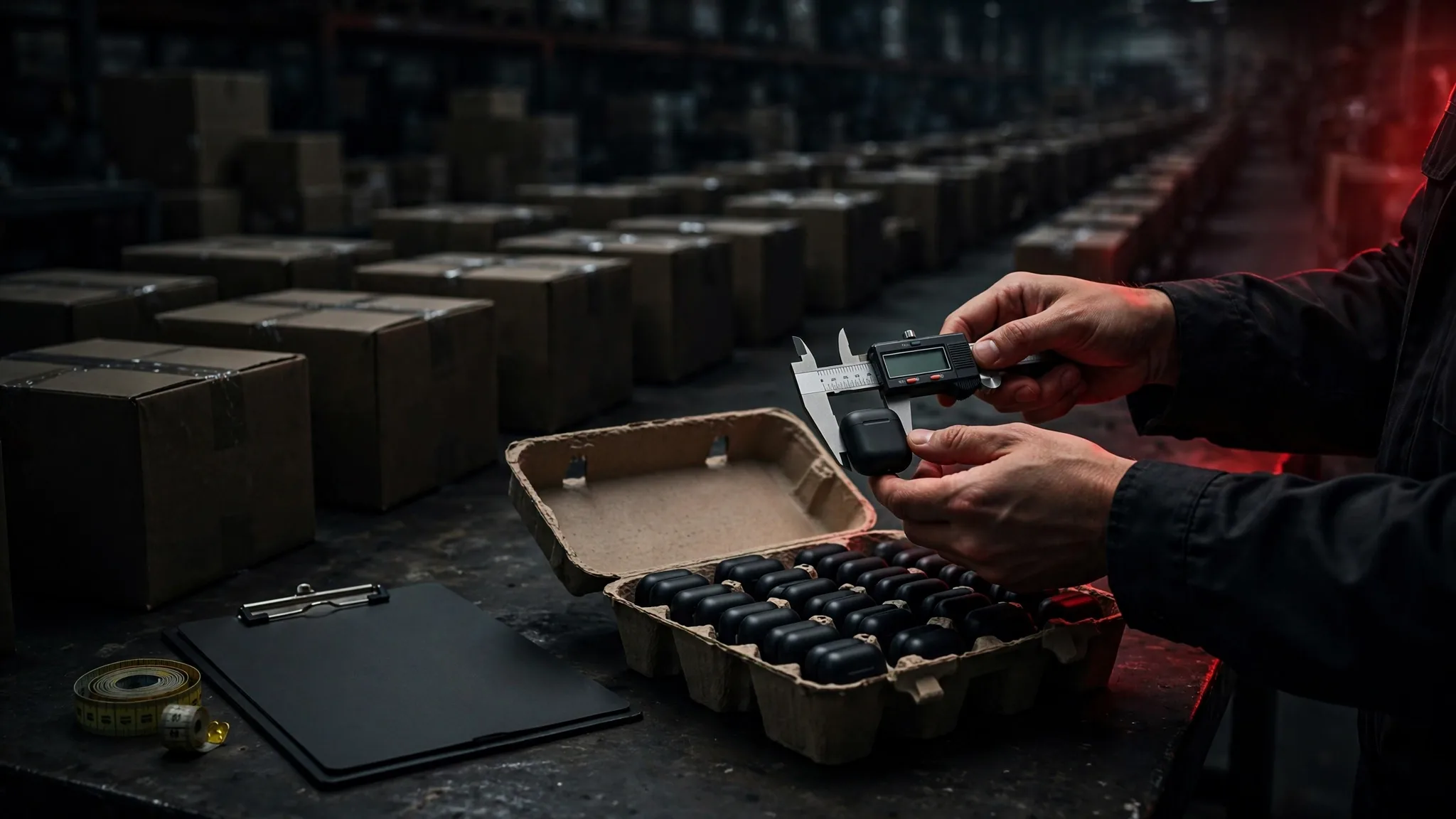
A China pre-shipment inspection checklist is the last line of defence between a factory's production run and your final payment. Once the container is sealed and on the water, every defect you failed to catch becomes your problem: your freight bill, your warehouse time, your returns. This checklist sets out what a competent inspector actually checks — quantity, specification, packaging, labelling, barcodes and function — how the sampling math works, and what to do when a shipment fails. Inspection only protects the margin if the numbers behind the order work too, so run your landed cost through our free landed cost calculator before you commit to the run, and if you would rather have the whole sourcing chain reviewed, ZAXIUS's free audit covers exactly that.
The short answer: a pre-shipment inspection is a check of finished, packed goods at the factory before you pay the balance. An inspector pulls a random sample sized by AQL tables, verifies quantity, specifications, packaging, labelling, barcodes and function against your spec sheet, photographs everything, and reports pass or fail while the goods — and your leverage — are still at the factory.
Why Pre-Shipment Inspection Beats Post-Arrival Arguments
Every dispute about a bad production run is really a dispute about timing. Discover a defect while the goods sit in the factory and you hold the strongest card in importing: the unpaid balance. The supplier can rework, replace or refund because the goods have not yet become your freight cost, your customs entry and your warehouse problem. Discover the same defect after arrival and the geometry reverses — returning goods to China is rarely economic, the supplier already has your money, and your realistic options shrink to discount-hunting and damage limitation.
Inspection also changes behaviour before it changes outcomes. A supplier who knows a third party will sample the run to an agreed standard produces differently from one who knows the first check happens in your warehouse. That is why experienced importers treat the inspection clause as part of the purchase agreement, negotiated alongside price and lead time, rather than as an optional extra booked the week before shipping. Our rundown of the China sourcing mistakes that cost sellers most puts skipped inspections near the top of the list for exactly this reason: the failure is rarely a surprise defect type, it is a defect type nobody was scheduled to look for.
AQL Sampling in Plain Language
Nobody inspects every unit on a normal order — the cost and time would exceed the value. Instead, inspectors sample to AQL (Acceptable Quality Limit) tables, most commonly the ISO 2859-1 / ANSI-ASQ Z1.4 standard. The idea is simple: the table tells the inspector how many units to pull, at random, from a production lot, and how many defects of each severity the sample may contain before the lot fails.
Three settings decide how strict the check is. The inspection level sets sample size relative to lot size; General Inspection Level II is the default for most consumer goods. The AQL values set tolerance per defect class — a common configuration is 0 for critical defects, 2.5 for major and 4.0 for minor. And the lot size — your total order quantity — drives the row of the table the inspector reads.
Worked example, with invented order details and the standard AQL table inspectors work from: you order 2,000 units of a kitchen gadget. At General Inspection Level II, a lot of 2,000 maps to a sample of 125 units. At AQL 2.5 for major defects, the lot passes with up to 7 major defects in the sample and fails at 8. The inspector finds 3 major defects and 6 minor ones (within the AQL 4.0 allowance of 10) — the lot passes, and the report documents every defect found so you can watch the trend on the next order. Change one input and the verdict changes: 8 major defects would fail the same lot. That is the whole point of agreeing the levels in writing before production — the verdict is arithmetic, not an argument about anyone's opinion of "good enough". A sourcing agent or inspection company will work to these tables by default; if you book an inspection and no one asks for your AQL levels, that is a warning sign about the inspection itself.
What a China Pre-Shipment Inspection Checklist Actually Covers
A serious checklist is organised around the ways a shipment can be wrong. These are the blocks your inspector should work through, in roughly the order they check them on the day:
- Quantity and assortment: total units counted against the order, per SKU, per colour or size variant. Short shipments and wrong variant mixes are caught here, while cartons can still be opened and corrected.
- Specification conformity: dimensions, weight, materials and construction measured against the signed spec sheet and the approved sample — calipers and scales, not eyeballs. Tolerances agreed in advance decide pass or fail.
- Function and safety tests: the product doing what it is sold to do — power-on, load, leak, drop and assembly tests appropriate to the type, plus any certification marks the destination market requires.
- Workmanship and appearance: scratches, dents, colour variation, glue marks, loose threads, print quality — scored as critical, major or minor defects against the AQL levels.
- Packaging: retail box condition, inserts and manuals present, protective packaging adequate for the journey, carton strength and packing method, units per carton matching the packing list.
- Labelling and barcodes: shipping marks correct, carton labels matching contents, and every barcode — FNSKU, UPC or EAN — scanned with a reader to prove it resolves to the right product. Unscannable or wrong barcodes are a classic cause of marketplace receiving chaos.
- Documentation on site: packing list totals reconciled with the cartons actually presented, and the inspector's own count recorded independently of the factory's paperwork.
Running the China Pre-Shipment Inspection Checklist: Step by Step
The checklist only works if the process around it is right. Run it in this order:
- Write the standard before production: spec sheet, approved sample, defect definitions and AQL levels go into the purchase agreement, with the inspection clause tied to the final payment — no passed inspection, no balance released.
- Book the timing correctly: schedule the inspection when production is 100 percent complete and at least 80 percent of goods are packed, so the sample represents the whole run and cartons can be checked as they will ship.
- Brief the inspector in writing: send the spec sheet, the approved sample photos, your known risk points (the seam that failed last time, the component suppliers substitute) and the exact barcode files to verify.
- Insist on random sampling: the inspector selects cartons from across the lot and pulls units themselves. Supplier-presented "samples" defeat the entire exercise.
- Read the report before paying: check the defect counts against your AQL verdict, look at the photos, and confirm the barcode scans and carton checks are documented — then release, hold or escalate.
- Close the loop: file the report with the order paperwork and carry its defect notes into the next order's brief, whether the verdict was pass or fail.
Cosmetic vs Functional Defects: What Fails a Shipment
Not every flaw is equal, and treating them as equal makes inspections slower and arguments longer. Inspectors sort defects into three classes:
| Class | What it means | Typical examples | Usual AQL |
|---|---|---|---|
| Critical | Can harm a user, break a law, or make the product unsellable outright | Exposed wiring, missing safety certification, wrong voltage, sharp edges on a children's product | 0 — any single one fails the lot |
| Major | The product does not work as sold, or a buyer would return it on sight | Unit will not power on, wrong size or colour, broken zip, missing accessory, barcode that scans to a different product | 2.5 (tighten to 1.5 for return-prone products) |
| Minor | Imperfections most buyers would not notice or would accept | Slight colour variation, a small scuff inside packaging, an uneven stitch that does not affect use | 4.0 |
The practical line: cosmetic defects cost you polish; functional defects cost you returns, reviews and marketplace account health. A shipment can pass with a scattering of minor defects and should still be watched — a rising minor count is usually the first sign of a process drifting before it produces majors. Agree the class definitions with examples for your product before the run, because the argument "that scratch is minor" is only winnable if the definition was written down first.
The Report: Photos, Measurements and the Paper Trail
The report is the product you are actually buying. A useful one contains the sample size and how it was drawn, defect counts by class with the AQL verdict, measured values against each key specification (not just "OK"), photographs of the goods, the defects, the packaging and the carton marks, and the barcode scan results. Photographs matter beyond the immediate decision: they are what you send the supplier when you require rework, what you show your freight forwarder or marketplace if a dispute reaches them, and what you compare the next order against.
Keep every report with its order file. Two or three reports across repeat orders tell you whether a supplier is stable, improving or drifting — information no single inspection gives you and no supplier will volunteer. If a report arrives as a single page with a stamp and no measurements, you have bought a stamp, not an inspection; change provider before the next order, not after a failed one.
When Inspection Fails: Rework, Discount or Reject
A failed report is not a disaster; it is the system working while you still have options. The three standard outcomes are rework (the supplier sorts, repairs or remakes the defective portion and you re-inspect the affected items, at the supplier's cost if your agreement says so), a price adjustment that honestly reflects the sorting or repair cost landing on you, or rejection of the shipment with the balance withheld until conforming goods are produced. Which one fits depends on the defect class: critical defects mean reject or full rework, majors usually mean rework and re-inspection, and a marginal minor-defect fail is where a negotiated discount is legitimate.
Two disciplines protect you here. First, never release the balance against a promise to fix things "next time" — the leverage is the payment, and it only exists once. Second, write the failure outcomes into the purchase agreement before production, so a failed report triggers a clause rather than starting a negotiation from zero. If you want an inspection plan built into your next order — spec sheet, AQL levels, booking timing and the failure clauses worded properly — that is part of the sourcing work ZAXIUS runs for clients, and the free audit is the place to start.
Price the order behind the inspection
Our free landed cost calculator stacks product cost, freight, duty and insurance into the true per-unit figure your inspection is protecting — run it before you confirm the order, not after the container lands.
Run the Landed Cost Calculator